

Kai Double-Sided Sharpening Stone 400/1000 Grit 25 cm
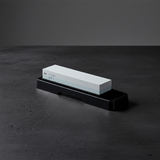
Professional Kai whetstone – Dual grit 400/1000 with support 25 cm
The Kai dual-grit 400/1000 whetstone is the reference tool for professional blade maintenance in the kitchen. Made of high-quality ceramic and produced in Japan by a brand with over a century of history in professional cutting, it offers on a single stone (25.2 × 9.4 × 5.0 cm) the abrasive grit for restoring damaged blades and that for daily maintenance. The included non-slip support ensures stability during sharpening and serves as a water immersion tray.
Grit 400 and grit 1000: two surfaces, one professional tool
The 400 grit is the coarse abrasive surface, designed to resharpen significantly worn or micro-chipped blades. It removes material efficiently, restoring the original edge profile in reduced times. It is the starting point for knives that have not received regular maintenance or have suffered mechanical damage.
The 1000 grit is the medium-grit surface, intended for daily blade maintenance: refines the edge, removes residual burrs from 400 grit work and restores a clean, precise cut. For knives in daily intensive use subjected to regular maintenance, 1000 grit is sufficient for routine maintenance without moving to 400 grit.
Why a perfectly sharpened blade changes kitchen work
In the foodservice industry and professional pastry, cut quality is not a detail: it impacts the precision of mise en place, plate presentation and operational safety. A correctly sharpened blade requires less force, reduces the risk of accidental slips and preserves ingredient structure. Whether Kai, Zwilling, Wüsthof, Global or any other professional knife, the Kai 400/1000 whetstone is compatible with both double-sided honed blades (European type) and single-sided blades (Japanese tradition).
Technical features of the Kai 400/1000 whetstone
- Available grits: 400 (resharpening) / 1000 (maintenance)
- Material: High-quality ceramic
- Dimensions: 25.2 × 9.4 × 5.0 cm (L × W × H)
- Included support: Non-slip tray with dual function (stabilisation and immersion)
- Blade compatibility: Double-edged blades (European) and single-edged blades (Japanese)
- Recommended sharpening angle: 15° for Western blades; for traditional Japanese blades, respect the original angle
- Usage method: Water-based (soak 10 minutes before use)
- Origin: Made in Japan
Professional sharpening instructions
Before using the whetstone, soak it completely in water for about 10 minutes. During sharpening, always maintain a light film of water on the surface: it ensures optimal blade cooling and consistent ceramic performance.
I. Double-sided honed blades (double-edged – European type)
a. Position the whetstone lengthwise in front of you on the work surface. Hold the knife with the edge facing you at 45° to the whetstone and tilt it at 15° to the surface.
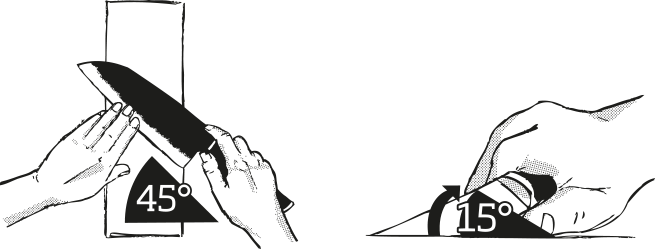
b. Start from the tip of the blade. Apply light pressure with your fingertips on the edge, eliminating any gap between whetstone and blade.
c. Push the knife away from you with light pressure, then return it towards you without pressure. Gradually shift your fingers towards the handle to cover the entire edge length. Repeat the cycle for at least five passes.
d. Turn the knife and repeat the process with the same number of passes on the other side.
e. Rinse the knife and whetstone thoroughly with clean water.
II. Single-edged blades (Japanese tradition)
a. Position the whetstone lengthwise in front of you. Hold the knife with the edge facing you at 45° to the whetstone, resting the sharpened side in the lower part of the abrasive surface.
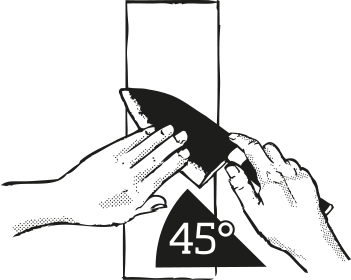
b. Start from the tip of the blade. Apply light pressure with your fingertips on the edge. The sharpening angle derives from the blade's original sharpening and should not be modified.
c. Push the knife away with light pressure, then return it towards you without pressure, moving your fingers towards the handle. Continue until you feel a burr forming* on the opposite side. At least five passes are necessary.

d. Turn the knife and rest the concave side of the blade flat on the whetstone. Push with light pressure until the burr is no longer felt. Alternatively, remove the burr with a nylon brush or newspaper.

e. Rinse the knife and whetstone thoroughly with clean water.
* A burr is a very thin layer of metal that forms during sharpening on the side opposite the whetstone.
Kai: over a century of Japanese excellence in blade production
Founded in 1908, Kai is the leading Japanese brand for the production of professional knives, scissors and sharpening tools. Kai whetstones are chosen by Michelin-starred chefs, top pastry laboratories and hospitality professionals who accept no compromises on cut quality. Choosing the Kai 400/1000 whetstone means investing in a blade maintenance system designed to last with consistent performance.